Queer Places:
University of Oxford, Oxford, Oxfordshire OX1 3PA
Brookwood Cemetery, Glades House, Cemetery Pales, Brookwood, Woking GU24 0BL, United Kingdom
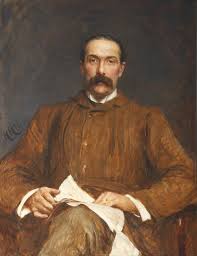 William Leonard Courtney (January 5, 1850 - November 1, 1928) was a prominent late-Victorian and Edwardian English philosopher, journalist, editor, and drama critic.
While he led a conventional personal life—marrying twice and raising a large family—his career placed him at the heart of key late-19th-century intellectual networks,
where he navigated and documented the aesthetic, literary, and social circles associated with Victorian homoeroticism and early LGBTQ history.
William Leonard Courtney (January 5, 1850 - November 1, 1928) was a prominent late-Victorian and Edwardian English philosopher, journalist, editor, and drama critic.
While he led a conventional personal life—marrying twice and raising a large family—his career placed him at the heart of key late-19th-century intellectual networks,
where he navigated and documented the aesthetic, literary, and social circles associated with Victorian homoeroticism and early LGBTQ history.
Born on January 5, 1850, in Poona, India, to an Indian Civil Service official, Courtney was educated in Bath and at University College, Oxford, where he excelled in
Classics (Literae Humaniores).
After brief stints as a fellow at Merton College and headmaster of Somersetshire College, he served as a philosophy tutor at New College, Oxford, from 1876 to
1890.
Courtney was known as a charismatic, dynamic figure on campus. He published foundational philosophical works—including The Metaphysics of John Stuart Mill (1879) and
Constructive Ethics (1886)—while coaching the college eight, managing the university boat club, and co-founding the Oxford University Dramatic Society (OUDS).
Seeking a broader platform beyond academia, Courtney moved to London in 1890 to join The Daily Telegraph as a principal literary and drama critic.
In November 1894, he took over as editor of The Fortnightly Review, a premier Victorian literary periodical. He edited the review for 34 years until his death on
November 1, 1928.
He married Cordelia Blanche Place in 1874 (with whom he had seven children). Following her death, he married scholar and editor Janet Elizabeth Hogarth in 1911.
While there is no historical record indicating Courtney identified as homosexual or queer himself, his role as a prominent Oxford don, drama critic, and editor of The
Fortnightly Review tied him directly to key figures and events in late-Victorian LGBTQ history:
During his 14 years at Oxford, Courtney operated in the same intellectual milieu as Walter Pater, whose writings on
Renaissance art and Hellenism laid the foundational aesthetic code for male homosocial and homoerotic expression in late-Victorian England. Courtney’s work with the
Oxford University Dramatic Society and his lectures brought him into close contact with young aesthetics and undergraduates drawn to Decadent movement ideals.
Courtney knew Oscar Wilde personally from Wilde's time as an undergraduate at Magdalen College, Oxford, and maintained
acquaintance with him in London’s theater scene.
Courtney assumed the editorship of The Fortnightly Review in late 1894, just months before the Wilde trial and conviction in May 1895.
While many periodicals launched harsh, moralizing attacks on Decadent literature and Wilde’s circle, historical records (including reminiscences by his second wife,
Janet Courtney) note that Courtney held "no animus against Wilde and his friends".
To protect the periodical and his writers during the intense public hysteria following Wilde's arrest, Courtney exercised cautious editorial censorship. For example, he
struck out references to Wilde in submitted essays, recognizing that public outrage required a temporary retreat from Wilde's name in print, while maintaining balanced
literary coverage.
Courtney was on friendly terms with John Addington Symonds, one of the earliest English cultural historians to write
openly (and privately) about male same-sex desire. As an editor and critic, Courtney engaged with the historical and philosophical ideas surrounding
Hellenism, Renaissance aesthetics, and the evolution of gender roles (which he later explored in his 1904 critical work The Feminine Note in Fiction).
References:
Other references:
- Courtney, Janet E. (Hogarth) — The Making of an Editor: W. L. Courtney, 1850–1928 (London: Macmillan, 1930)
- Courtney, Janet E. (Hogarth) — "The Fortnightly Review under Courtney, 1894–1928" (Reprinted/Archived in The Fortnightly Review)
- Oxford University Archives & Records
- Matz, B. W. — "The Fortnightly: A Retrospect" (First published in The Fortnightly Review, January 1901)
- Ellmann, Richard — Oscar Wilde (Knopf, 1987)
- Brake, Laurel and Demoor, Marysa (Eds.) — Dictionary of Nineteenth-Century Journalism in Great Britain and Ireland (Academia Press/British Library, 2009)
Support this project
This website is a passion project researched, developed, and funded entirely by me. If you find the content valuable and would like to help support the ongoing research and hosting costs, any contribution is deeply appreciated.
Thank you for keeping this independent resource alive!
My books on Amazon: Elisa Rolle's books
BACK TO HOME PAGE
